
Soundbar Integration in Custom Media Walls: The Right Way
Three integration approaches: dedicated shelf, recessed flush, or invisible-grille. How to choose, what each costs, and which soundbars work best in each.
by Walora Design TeamUpdated 9 min read

The soundbar is the audio centre of most modern media walls, and how it's integrated determines whether the wall looks like a finished piece of architecture or like a TV mount with a black bar awkwardly perched below.
The three integration approaches
Approach 1 — Dedicated shelf
A horizontal shelf at the right height below the TV, designed to hold the soundbar with proper cable routing and ventilation. The soundbar sits on the shelf; from across the room it reads as a unified TV-and-soundbar element.
This is the most common premium integration and the simplest. The shelf depth matches the soundbar depth (so the soundbar sits flush with the front of the shelf). Cables route inside the wall directly to the TV above. The soundbar is removable for service or upgrade.
Best for: most buyers, most apartments, most soundbars. Cost added: minimal — typically included in the wall design.
Approach 2 — Recessed flush
The soundbar fits into a routed niche in the wall surface, with its front face flush with the surrounding wall. The soundbar effectively becomes part of the wall.
The niche is precision-cut at fabrication. Cable routing happens directly behind the niche. Heat venting is incorporated (small slits or a rear-vent design) because soundbars need airflow.
Best for: buyers wanting a maximally architectural integration; apartments where the wall reads as a continuous surface. Cost added: AED 2,000–4,000 over the dedicated-shelf approach. Trade-off: front-firing soundbars only — up-firing Atmos drivers don't work in a recess.
Approach 3 — Invisible grille
A fabric or perforated metal panel conceals the soundbar entirely. The room sees no electronics — just a continuous wall surface. Audio passes through the grille.
This is the most architecturally pure approach and the most demanding. The grille must be acoustically transparent (about 70 percent open area), positioned precisely so each driver fires cleanly through it, and visually consistent with the surrounding wall material.
Best for: buyers committing to a fully concealed AV aesthetic. Cost added: AED 3,000–6,000. Trade-off: significant design and material planning; the grille panel is a noticeable design choice.
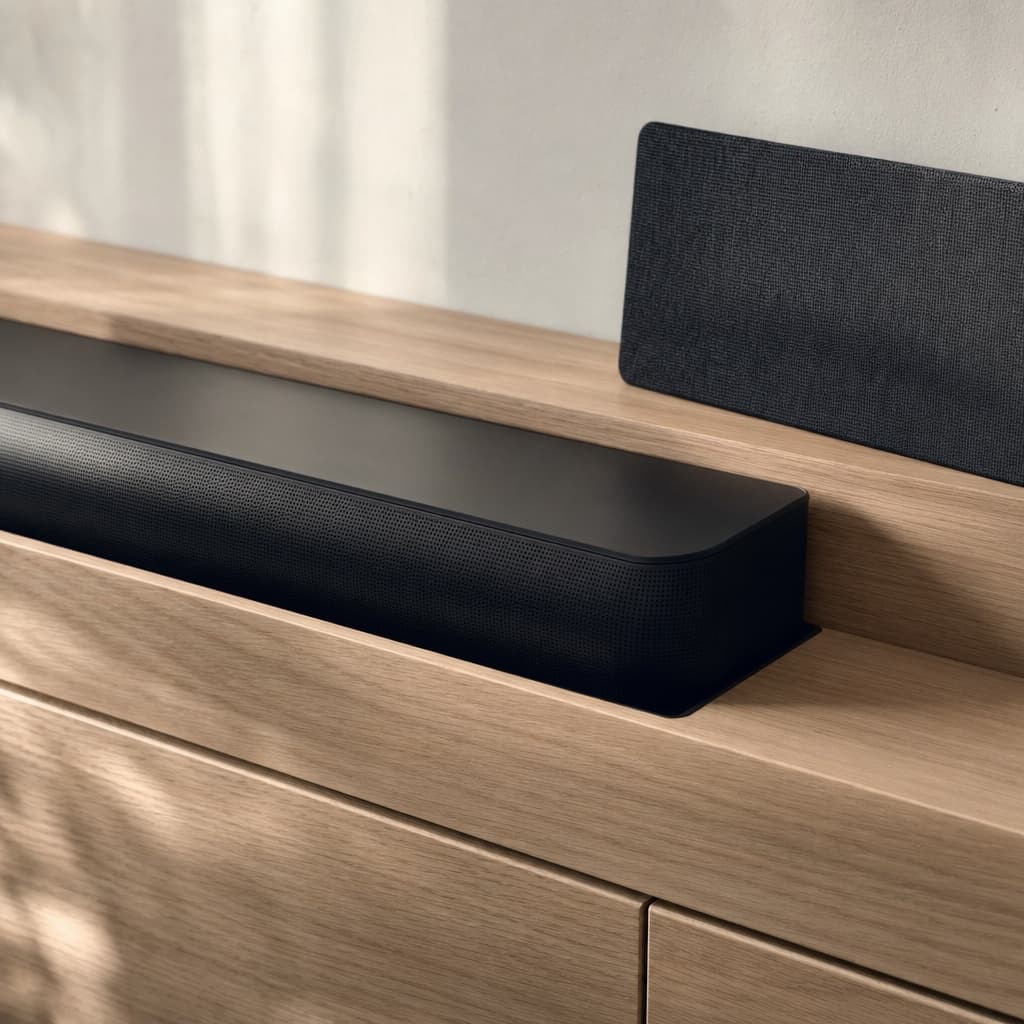 A premium soundbar seated in a precisely-CNC'd cavity in warm-oak cabinetry, with the acoustic fabric grille panel beside it.
Soundbar selection — the pairing that matters
Soundbar quality varies enormously, from AED 800 cheap models to AED 25,000 reference units. For a premium media wall, the soundbar shouldn't be the weak link. Three tiers worth considering:
Mid-premium (AED 2,500–5,000)
- Sonos Beam (Gen 2) — compact, full Dolby Atmos, voice control, integrates with Sonos ecosystem
- JBL Bar 1000 — discrete rears included, strong for the price
- Samsung Q990C — flagship Samsung soundbar with discrete rear units
Good for buyers prioritising TV audio over music quality.
Premium (AED 6,000–12,000)
- Sonos Arc — flagship Sonos, 11.0 effective channels, integrates with Sonos rears
- Sennheiser Ambeo Soundbar Plus — exceptional Atmos rendering, no rear speakers needed for surround effect
- Bose Smart Soundbar Ultra — strong TV audio, decent music
The category that buyers focused on premium TV audio land on most often.
Reference (AED 12,000–25,000)
- Bang & Olufsen Beosound Stage — beautiful industrial design, real audio capability, premium materials
- Sennheiser Ambeo Soundbar Max — physically large, exceptional sound stage
- Devialet Dione — sphere-mounted tweeter, distinctive look, premium audio
For buyers where the soundbar is itself a design element of the wall.
What about discrete speakers?
For the most demanding buyers, discrete speakers — proper individual speakers placed at acoustic positions in the room — are the next tier.
In-wall speakers: Sonance, KEF Ci, Bowers & Wilkins CT, Triad. Recessed into the wall structure with paintable acoustically-transparent grilles. Invisible from the room when finished; sound significantly better than any soundbar for music; equivalent or better for TV.
In-ceiling Atmos speakers: For full surround sound, 2 to 4 in-ceiling speakers placed above the seating area provide proper height channels.
Discrete subwoofer: Concealed inside a base cabinet of the media wall (vented carefully), or wireless and placed in a corner.
Cost adds up: AED 6,000–25,000 over the equivalent soundbar setup. The audio improvement is significant for music; modest for TV-only use. Right answer for the music-focused subset of buyers.
Width and proportion
The width relationship between TV and soundbar matters more than buyers expect. Three patterns:
-
Soundbar narrower than TV by 10–30cm: Natural, balanced. The TV remains the focal point; the soundbar sits below as a secondary element.
-
Soundbar matches TV width within 10cm: Strong horizontal element. Reads as a deliberate unified design.
-
Soundbar much narrower than TV (40cm+ shorter): Stranded. The soundbar looks accidentally placed below a wide TV.
-
Soundbar wider than TV: Generally avoid. The soundbar dominates a screen it's meant to support.
A 75-inch TV (166cm wide) pairs well with soundbars between 130cm and 170cm. Most premium soundbars fall in this range; cheap soundbars often don't, which is why mismatched proportions are usually a sign of an under-budgeted audio component.
Cable routing for the soundbar
The cables involved:
- HDMI ARC from TV to soundbar (one cable for sound back from the TV)
- Power to the soundbar
- Network (premium soundbars use Wi-Fi and Ethernet) — optional but recommended for stability
These need to route inside the wall structure from the TV position down to the soundbar position. A 30mm channel inside the wall handles this comfortably with room for future additions.
If wireless rear speakers are planned, their power cables also need to be hidden — usually run inside skirting trunking from the soundbar position to outlets behind the sofa.
The bedroom soundbar question
Bedrooms with TVs sometimes need a smaller, quieter audio solution than a living-room soundbar. Three options:
- A compact soundbar (Sonos Beam, Sonos Arc in smaller bedrooms) on a wall-mounted shelf below the TV.
- In-ceiling speakers integrated with the bedroom's TV — discrete and architectural.
- The TV's built-in speakers (acceptable for casual viewing; not really audio).
For premium bedroom installations, in-ceiling speakers paired with a small AV receiver hidden in a wardrobe is the cleanest answer. The room reads as a bedroom, not a TV room, even when the TV is fully functional.
Frequently asked questions
About the author
The Walora Design Team has been crafting custom media walls for UAE homes since 2024 — every piece built to order in our Dubai workshop from real natural stone, premium stained wood veneers and bin-matched LED.
Related reading
Planning Your Space10 min read
TV Sizing Guide: Matching a 65, 75, or 85-Inch Screen to Your Wall
Viewing distance, wall proportions, and the SMPTE / THX guidelines applied to UAE apartment dimensions. How to choose a screen that looks right against the wall and from the sofa.
Planning Your Space10 min read
How to Measure Your Wall for a Custom Media Unit (Step-by-Step)
A measuring guide good enough to ground-truth a designer's site visit. Tools, sequence, what to record, and the four mistakes that delay 40% of projects.
Planning Your Space11 min read
How to Hide a TV in a Media Wall Without Compromising the Picture
Disappearing screens, art-mode displays, hidden compartments, sliding panels — the four ways to remove the TV from view, and what each one trades off.