
How to Hide a TV in a Media Wall Without Compromising the Picture
Disappearing screens, art-mode displays, hidden compartments, sliding panels — the four ways to remove the TV from view, and what each one trades off.
by Walora Design TeamUpdated 11 min read
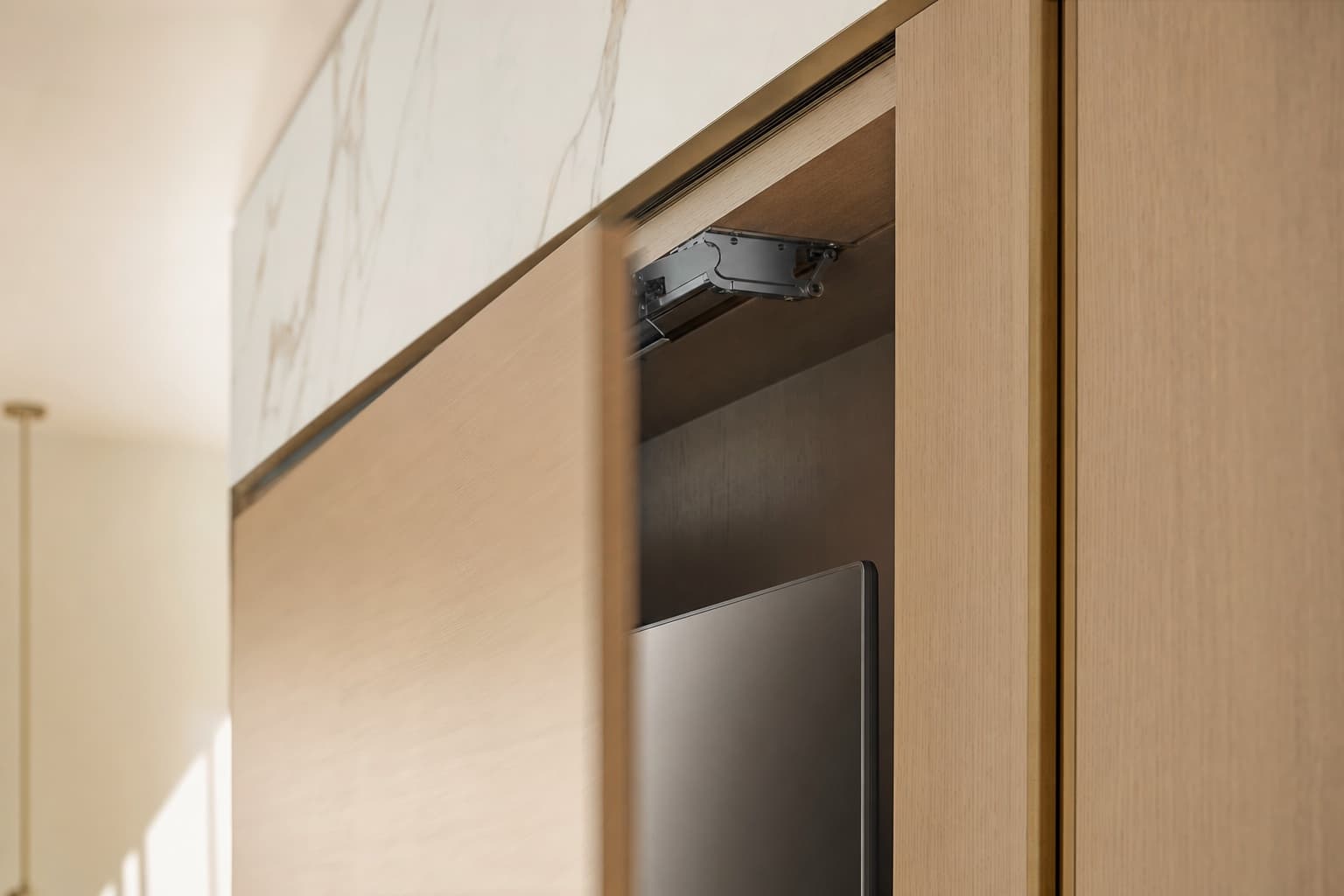
The question every premium media-wall buyer eventually asks: how do I make the TV go away when nobody's watching it? Four answers, each with trade-offs.
Why hide a TV at all?
A black rectangle 165cm wide on the wall is visually dominant whether it's on or off. For viewers who watch TV every evening, this is irrelevant — the screen is part of the room's identity. For viewers who use the TV for occasional sport, movies, news, or as background ambience, the off-state of the screen is where the room lives 80 percent of the time.
A hidden TV transforms the room when not watching. The wall reads as a continuous architectural element rather than as a TV mount. Guests don't notice the TV. Photos of the room are uninterrupted by black rectangle. The room earns more uses than just watching.
The trade-off is friction: each hiding method adds some action to the TV-on moment. The question is whether the off-state benefit is worth the on-state cost.
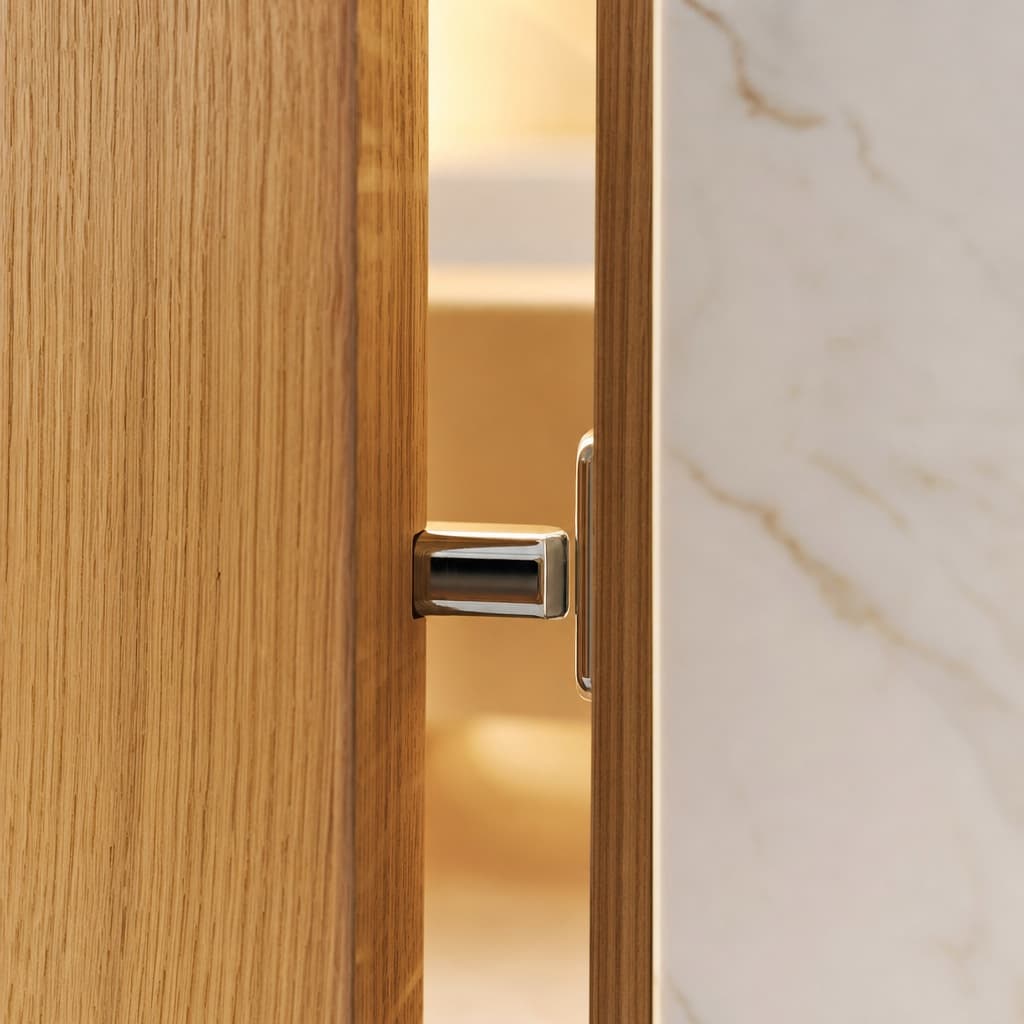 Macro detail of a magnetic soft-close latch on the edge of a sliding warm-oak veneer panel.
Method 1 — Art-mode TVs
The lowest-friction option, and the easiest premium upgrade.
Several brands now make TVs designed to look like art when off: Samsung's Frame series (the leading product), LG's Gallery, Hisense Canvas. The display uses a matte anti-glare panel that reads like printed art, the bezels are interchangeable (wood, metal, leather), and the proprietary art-mode software displays high-resolution images from a catalogue (Samsung's art store has thousands of pieces, including major museum collections).
The key qualifier: it has to look like art when seen at conversation distance. The Frame achieves this convincingly. Earlier or cheaper attempts don't — the screen still reads as a screen.
The trade-offs:
- Price: Frame TVs cost 20–30 percent more than standard QLEDs of the same size.
- Picture quality: Frame TVs use LCD/QLED panels, not OLED. Picture quality is competitive but not class-leading. For most viewers — daytime TV, sport, news — it's plenty. For cinephiles watching dark-scene movies in low light, OLED is meaningfully better.
- Power consumption: Art mode uses around 12W continuously. Roughly AED 80–120 per year on the electricity bill.
- Photo quality of displayed art: Some images look better than others. Smooth large blocks of colour (paintings) work well; photographs with subtle gradients can look slightly digital.
For most buyers seeking a hidden TV, Samsung's Frame is the right answer — it's the lowest-friction, lowest-price, lowest-complexity option that genuinely delivers the effect.
Method 2 — Sliding panel
The cleanest architectural hide. A panel — usually a stone or veneer surface — slides laterally across the wall to cover or reveal the TV.
Done well, this is dramatic. The wall reads as a continuous stone or veneered surface; press a button, the panel glides to one side, the TV appears behind. Close, the panel slides back, the wall is whole again.
Mechanically: a horizontal track (usually concealed at the top of the wall) carries the panel. The track is either manual (you push the panel by hand) or motorised (remote or smart-home-controlled). Premium motorised systems use the same brands as premium curtain tracks (Lutron, Somfy).
Trade-offs:
- Cost: AED 4,000–9,000 over the fixed-panel equivalent.
- Wall width needed: The panel needs somewhere to slide to. The wall must be ~1.7x the TV's width to give the panel parking space.
- Maintenance: Track and motor are mechanical parts; they need occasional service.
- Friction: 3 seconds to open, 3 to close. Low but non-zero.
The right answer for buyers who want maximum architectural impact and have the wall length to accommodate the panel.
Method 3 — Lift mechanism
A TV that rises from a cabinet. The most dramatic option visually; the most mechanically complex.
A lift mechanism (Future Automation, Pro-Lift, Vutec are the premium brands) is mounted inside a base cabinet. When activated, a motor raises the TV from inside the cabinet up to viewing position. Above-cabinet space stays clean when the TV is hidden.
Realistically: lifts are best suited to occasional viewing. The mechanical action takes 8–12 seconds — fine for movie nights or guest entertainment, slow for daily news watching. The mechanism adds noise (faint motor sound) and cost (AED 8,000–18,000 for premium lifts).
Best applications:
- Bedrooms (TV rises from a console at the end of the bed)
- Cinema rooms (TV emerges from a console below a screen)
- Living rooms where the TV is genuinely used occasionally
Less suited:
- Daily viewing rooms (the friction adds up)
- Smaller apartments (the cabinet depth for a lift is 200–280mm, larger than a standard media wall cabinet)
Method 4 — Two-way mirror
The TV is mounted behind a partially-reflective glass panel. When off, the panel reads as a mirror. When on, the TV image transmits through the mirror layer.
The effect is striking — a mirror that suddenly becomes a screen feels almost magic on first view. After the magic wears off, the trade-offs become visible:
- Brightness loss: 25–40 percent of perceived brightness. Modern OLED TVs handle this; cheaper TVs look noticeably dim.
- Reflection in bright rooms: The mirror reflects bright daylight onto the screen, which makes the image harder to see during the day.
- The mirror itself: a large mirror is a strong design element. Whether it works in the room is a question of overall aesthetic, not just the TV hide.
Best applications:
- Bathrooms (TV behind bathroom mirror — there's actually a market for this)
- Bedrooms (TV behind a vanity or wardrobe mirror)
- Limited use in living rooms
For most buyers, sliding panels or art-mode TVs cover the same need with fewer compromises.
How to choose
Match the hide to the viewing pattern:
- TV on every evening, often for several hours → Art-mode TV (Samsung Frame) is the only zero-friction hide; everything else is friction overhead.
- TV used 2–3 times a week, mostly for movies or sport → Sliding panel works well; the friction is acceptable for the lower frequency.
- TV used occasionally, mostly for guests or entertainment → Lift mechanism or two-way mirror are options; the dramatic effect is worth the friction.
- TV is a secondary feature in the room → Sliding panel is most architectural; art-mode is most practical.
The wrong combination is a high-friction hide (lift, sliding panel) with daily heavy viewing. Within months the family stops using the hide and the TV is permanently visible — meaning the cost of the mechanism was wasted.
What never quite works
Two ideas that get asked about and rarely deliver:
Pictures hung over the TV
A picture frame designed to flip or hinge over the TV. The mechanism is rarely smooth; the picture rarely looks like art (its weird mechanical mount gives it away); the result reads as a workaround rather than a design choice.
Curtains over the TV
A fabric panel that draws across the wall like a curtain. Visually heavy, mechanically fiddly, and the fabric is a dust collector in a room. Rarely chosen except in very theatrical interiors.
The honest summary
For most premium media-wall buyers in the UAE, two options handle 90 percent of needs:
- Samsung Frame — for buyers who watch TV often and want the off-state to disappear with zero friction.
- Sliding panel — for buyers who want maximum architectural integration and can accept a 3-second open/close.
The other options are interesting in specific contexts but rarely the default answer. The most important step in choosing is being honest about how often the TV is actually used, and matching the hide to that pattern rather than to the visual drama of the mechanism.
Frequently asked questions
About the author
The Walora Design Team has been crafting custom media walls for UAE homes since 2024 — every piece built to order in our Dubai workshop from real natural stone, premium stained wood veneers and bin-matched LED.
Related reading
Planning Your Space10 min read
TV Sizing Guide: Matching a 65, 75, or 85-Inch Screen to Your Wall
Viewing distance, wall proportions, and the SMPTE / THX guidelines applied to UAE apartment dimensions. How to choose a screen that looks right against the wall and from the sofa.
Planning Your Space9 min read
Soundbar Integration in Custom Media Walls: The Right Way
Three integration approaches: dedicated shelf, recessed flush, or invisible-grille. How to choose, what each costs, and which soundbars work best in each.
Planning Your Space10 min read
How to Measure Your Wall for a Custom Media Unit (Step-by-Step)
A measuring guide good enough to ground-truth a designer's site visit. Tools, sequence, what to record, and the four mistakes that delay 40% of projects.