
Real Wood Veneer vs Foil Wrap: A Field Guide for Buyers
Three near-identical surfaces with very different lifespans. How to tell European stained veneer from foil wraps and printed laminates before you pay for the wrong one.
by Walora Design TeamUpdated 9 min read
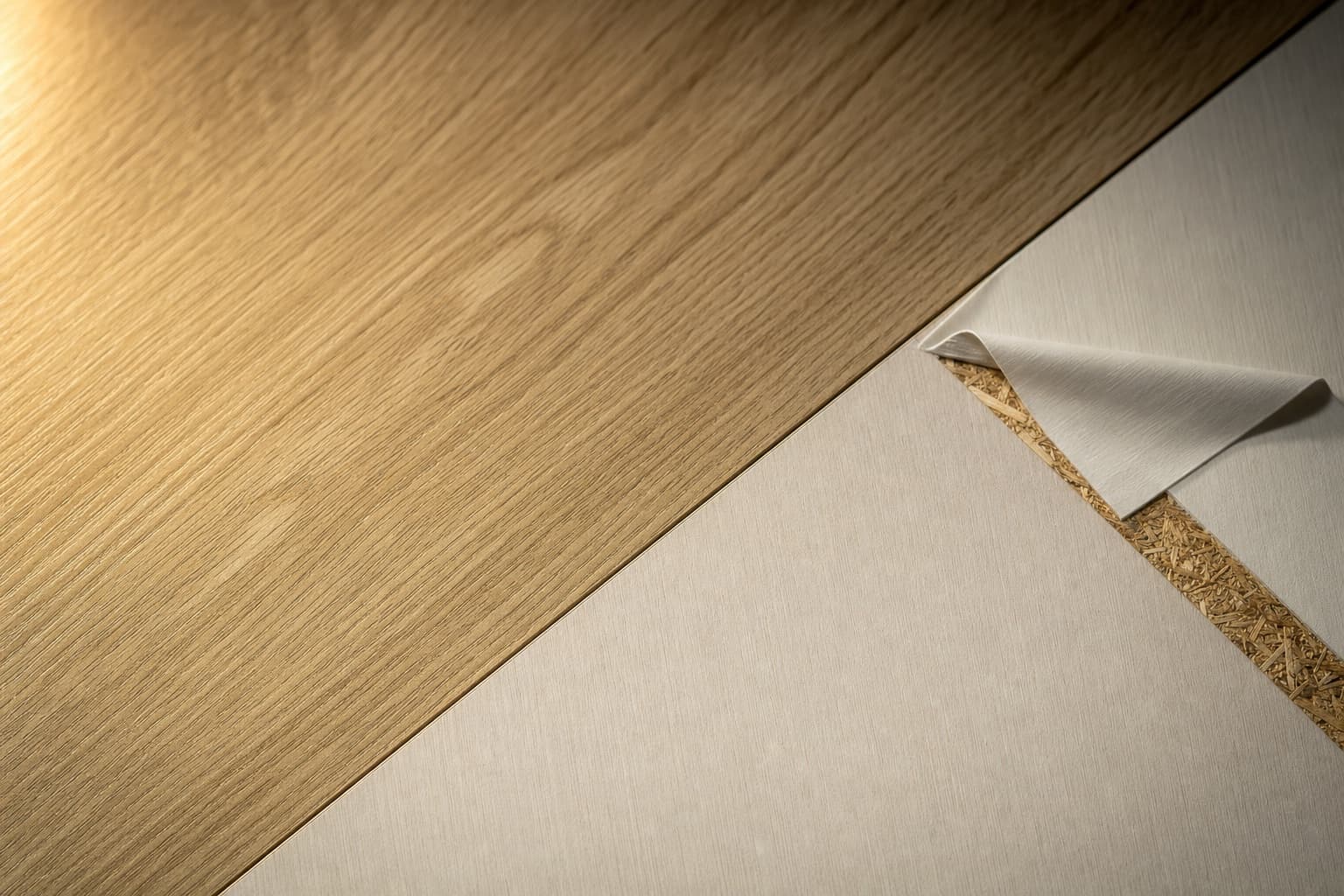
Most modern media walls use some kind of wood surface — a feature panel, cabinet doors, an entire TV console wrap. Whether that surface is real veneer or printed plastic film is the single biggest determinant of whether the unit looks right in five years.
What real wood veneer actually is
Veneer is the answer to a simple question: how do you put real wood on a large flat surface without the surface warping?
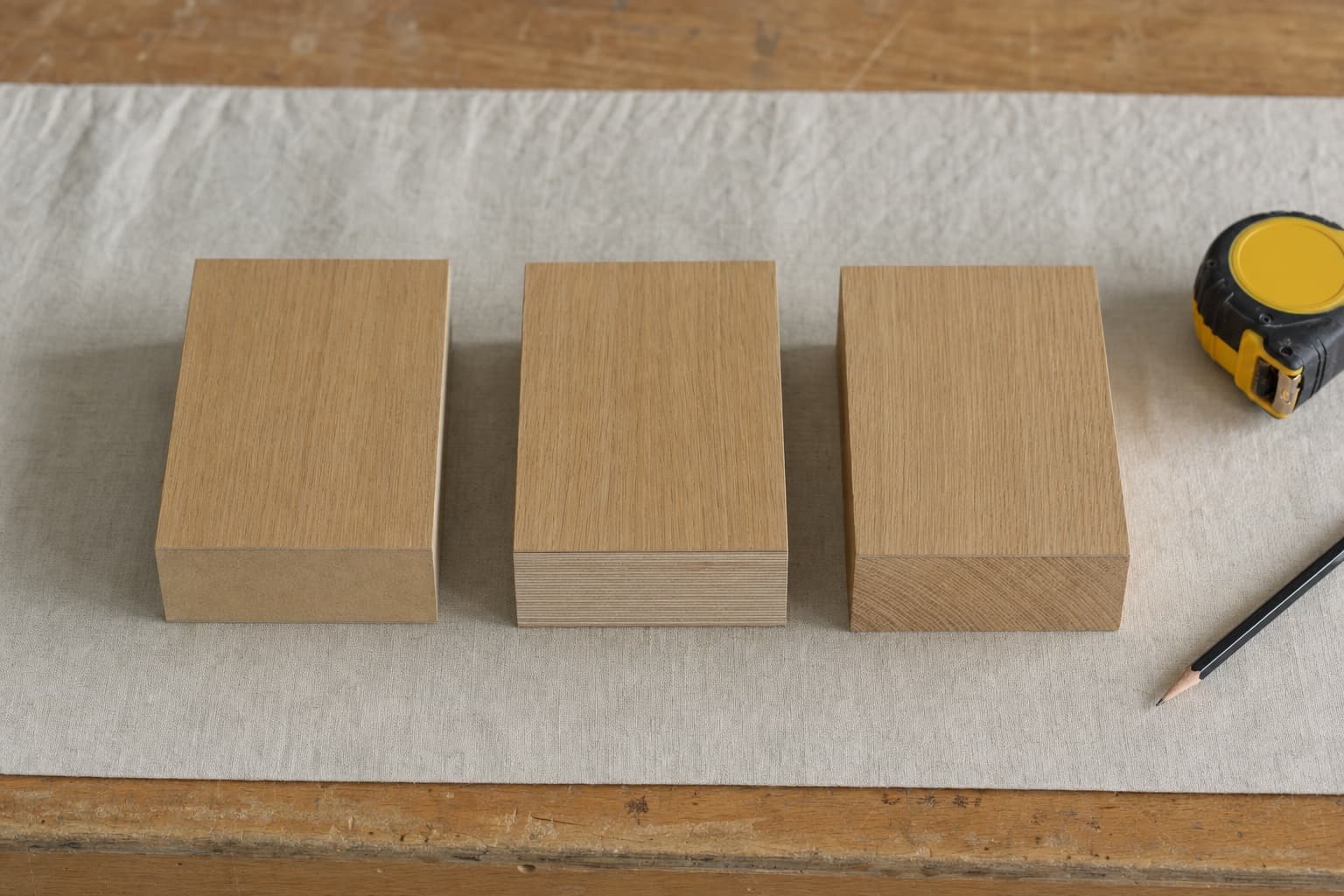
A log of timber — oak, walnut, ash, sapele, eucalyptus — is mounted on a slicer and shaved into thin sheets, typically 0.4 to 1.5 mm thick. These sheets are bonded to a stable substrate (engineered MDF or plywood) with industrial adhesives, pressed flat, and finished with stain and lacquer. The result is a panel that behaves like a board and looks like a slab of timber.
Premium veneer comes from large logs sliced into long, consistent sheets that can be book-matched, slip-matched, or random-matched across cabinet faces. The match is done by hand at the mill — picking which sheets sit next to which to create continuous-looking grain across a wall of cabinet doors.
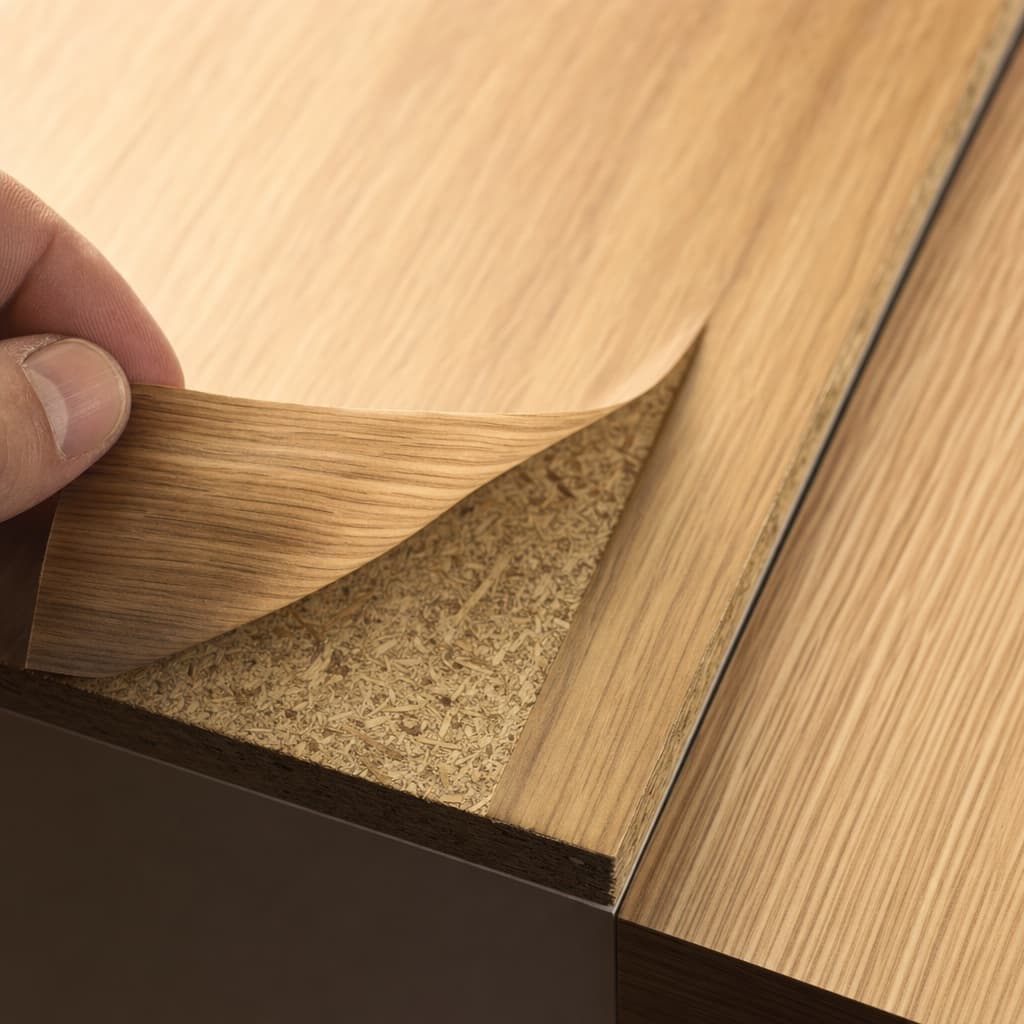 A finger gently lifting the peeling corner of a foil-wrap finish next to a panel of real warm-oak veneer.
What foil wrap actually is
Foil wrap is a printed PVC or PP plastic film, between 0.2 and 0.5 mm thick, with a wood-grain pattern printed on it. The film is heated, draped over a routed MDF panel, and pressed into place using vacuum or membrane forming. The adhesive activates with heat, and the foil takes on the shape of the panel including any edge profile.
The economics are unbeatable: foil-wrapped doors are about a third of the cost of veneered doors at point of sale. The problem is what happens to those doors over time in UAE living conditions.
The seven-second showroom test
Walk to any cabinet door and run your fingernail along the grain. With real veneer you will feel the wood's open pores — small, irregular, slightly catching. With foil and HPL the surface is uniform and slick. The eye sometimes lies; the fingertip rarely does.
A second test: look at the edge of a door. Real veneer doors are edge-banded with a matching strip of the same veneer, finished to the same colour. The seam between the face and the edge band is barely visible. Foil-wrapped doors have foil that turns the corner from the face onto the edge — meaning when (not if) the foil starts to lift, the lift will begin exactly at that corner. HPL doors usually have a PVC edge strip in a near-matching colour with a slightly visible seam.
A third test: ask the supplier for an offcut of the panel and look at it under direct sunlight. Real veneer will show variation in grain density and tone across the offcut. Foil and HPL will show the same pattern at the same density everywhere because the pattern is printed.
Why foil wrap fails specifically in UAE homes
Three things converge to make UAE living conditions tough on foil wrap:
-
AC cycling. Interior air swings from 22°C and dry to 30°C and humid daily, every time a door opens. The MDF substrate expands and contracts; the foil's adhesive layer fatigues.
-
Direct sun. UAE apartments often have generous windows facing west. UV breaks down PVC. Foil sections exposed to direct sun fade and become brittle within a couple of years.
-
Heat sources. Media walls sit near televisions, soundbars, and amplifiers — all of which generate localised heat. Foil wraps de-laminate fastest right where the heat is highest.
The result is a furniture failure mode that's unique to climates like ours. Identical foil-wrapped cabinets in cooler, drier European apartments will last twice as long as they do in Dubai. This is one of the reasons mainstream furniture from European catalogues sometimes underperforms here.
Why veneered MDF beats solid wood for media walls
This is one of the most common misunderstandings in the category. Buyers assume solid wood is automatically the premium option. For large flat panels in UAE climate, it usually isn't.
Solid wood is a living material. It expands and contracts with humidity, warps when one side is wetter than the other, and develops surface checks (small splits) when humidity swings are large and rapid. UAE apartments deliver exactly the swings that solid wood handles worst.
A veneered engineered panel — typically 18 mm MDF or birch plywood with a real wood face — solves the dimensional problem while keeping the real-timber surface. The substrate doesn't move with humidity; the veneer shows the same grain a solid piece would. Every serious European furniture maker uses this construction for large flat panels.
Solid wood does still have a role in media walls: legs, plinths, edge profiles, sometimes drawer fronts where its dimensional behaviour is easier to manage. The slabs, doors, and shelving on a premium piece will almost always be veneered.
The bottom line for buyers
If a supplier quotes "premium wood finish" without naming the construction, assume foil. If they name the construction as "real veneer over MDF" or "engineered timber panel", ask which veneer, which mill, what thickness. The willingness to answer those questions in writing is the strongest signal of where the piece will sit on the quality curve.
The economics matter, too: real veneered cabinetry costs roughly 1.5 to 2 times the foil-wrapped equivalent and lasts roughly three times as long. Per year of life, real veneer is cheaper. Per minute of looking at it, it is meaningfully more beautiful.
Frequently asked questions
About the author
The Walora Design Team has been crafting custom media walls for UAE homes since 2024 — every piece built to order in our Dubai workshop from real natural stone, premium stained wood veneers and bin-matched LED.
Related reading
Materials & Finishes9 min read
Real Marble vs Marble-Effect Panels: How to Tell the Difference
Solid stone slabs, marble-laminate sheets, sintered stone, HPL panels — what each one actually is, and how to spot the cheapest version of each.
Materials & Finishes8 min read
Premium Lacquer vs Standard Paint: What's Really on Your Cabinet
Furniture-grade matte lacquer is a five-step build. Standard painted cabinets are usually two coats with no primer. Here's how to spot which one you're buying.
Materials & Finishes9 min read
MDF, Plywood, or Solid Wood: What Should a Media Wall Be Built From?
The substrate question every buyer eventually asks. Why furniture-grade MDF often beats solid wood in UAE climate, and where plywood is the only right answer.